Gunite Bridge
Also known as Gunited Concrete Footbridge, Free Form Bridge.
No. 12 · 1965
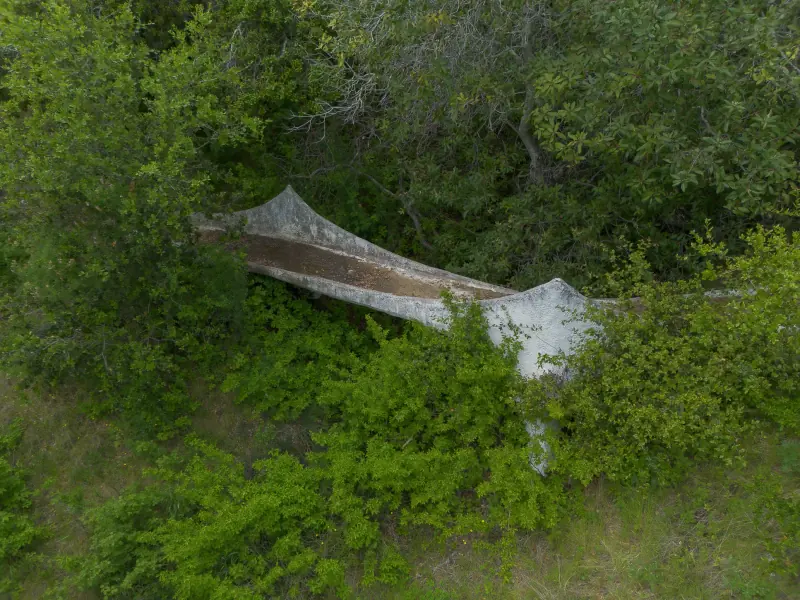
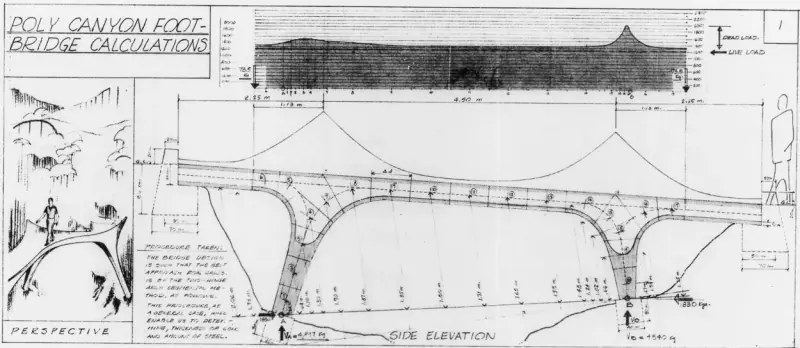
This bridge wasn’t just about engineering—it was about proving an idea. The team wanted to challenge traditional bridge-building techniques by using as little material as possible without sacrificing strength. Their solution? A thin-shell concrete structure that used pre-tensioned cables to hold its form during construction, only to have those cables cut after curing, allowing the structure to settle into pure compression. At the time, this was a largely untested approach, and the team later discovered that only one other similar structure existed in the world, in Brazil.
But the project wasn’t just about technical challenges. The students had to fund it themselves, securing $1,500 in donations and convincing companies to contribute steel, concrete, and specialized equipment. They worked with a prototype gunite machine, developed precision construction methods, and performed all calculations manually with slide rules, long before structural analysis could be done with computers. Even the bridge’s formwork was unconventional—early design models were shaped around women’s nylons and stockings, stretched over frames to visualize how the thin shell might behave.
The bridge was originally designed with mounts for railings, as they were required, but the team saw them as unnecessary. The railings were never installed, and on graduation day, Gordon Boles personally went out and cut off the mounts to maintain the bridge’s clean, uninterrupted form.
Nearly 60 years later, the Gunite Bridge remains one of the longest-standing experimental structures in the canyon, proving that efficiency and precision can outlast even the strongest traditional designs.
Builders and advisors
- Wesley Ward — Advisor
- Gordon Boles (ARCE) — Builder
- Roy Leland Bostrom (ARCE) — Builder
- Kokpo Ng (ARCE) — Builder
- Richard Saylor (ARCE) — Builder
- John Ulloa (ARCE) — Builder
- Hans Mager — Advisor
- Hubert Bromma (ARCE) — Builder
gunite construction, thin-shell design, tension and compression, innovative bridge technique, minimal material use, white sand veneer, reinforced steel skeleton
Location
Sources & further reading
Photographs